SAAM Days 13 & 14 – Rape Culture

A few days ago I got into a discussion with someone about rape culture. That’s a phrase used to describe the ways in which society blames victims of rape and sexual violence, and normalizes that violence (particularly male violence against women). It comes through reporting and discussion on rape cases, through jokes that perpetuate the idea that women should learn to expect violence, and through anything that sexualizes women to the point where they don’t exist as human beings, and that which makes coercion seem acceptable.

The person I was talking with (online) about rape culture denies that it exists, or at least not in the United States and other, in her words, developed countries. It might be, she conceded, a reality in the third world, or in places where women aren’t valued, and don’t have equality. (Again, all this person’s words, not mine.)

Eventually, tired of beating my head against a wall, I gave up trying to persuade this person that rape culture is real. I had more efficient ways to spend my time, like trying to persuade my kitten that she doesn’t need to knock everything off the dresser at night.

Meanwhile I offer you these two amazing spoken word poets on the question of rape culture & consent.

First, “I’m Sorry Poem” by FreeQuency


And then, “Word Choice” by Imani Cezanne


And if you would like to read more about the reality of rape culture you can start here:
What Is Rape Culture – Women Against Violence Against Women


SAAM Days 10 to 12 – Weary

I’ve been feeling a little off these past few days. Some of it is a lingering cold, and now the fun of allergies since spring is really (maybe, hopefully) coming to northern Wisconsin.

But there’s also a feeling of vulnerability with having my story out there in the world, out of my hands where others can read it, and analyze it, and criticise it without consulting me. That’s something every survivor who tells their story faces – letting go of control of their story; and if there’s one thing all the survivors I know hate it’s not being in control because once, when we were raped, we had no control. It’s a scary thing, and at least to me, a necessary thing, but it does leave me feeling like a turtle without a shell sometimes.

And then there’s the sense that I’m not doing enough. If I don’t post here every day, I’m letting my survivor sisters and brothers down. If I don’t speak up about every case of rape and sexual assault that comes across my news feed, I’m not doing enough to advocate for change. If I let a joke go by, or don’t correct someone’s language, or … it goes on and on, the sense that there is never enough I can do.

So I’m going to go and do some painting, and watch “Iron Jawed Angels” about the women’s suffrage movement (most appropriate today because President Obama announced a national women’s equality monument at Belmont-Paul House … if you don’t know about it, please go look up Alice Paul, and Alva Belmont, and Inez Milholland, and Ida Wells, and so many more).

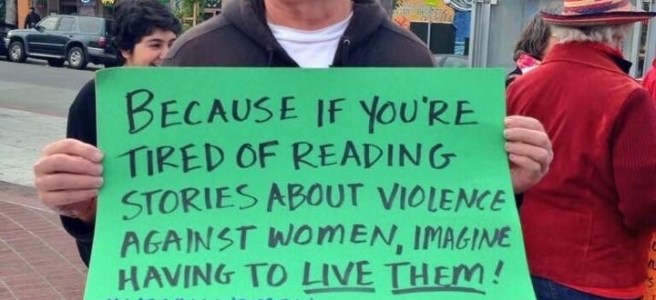
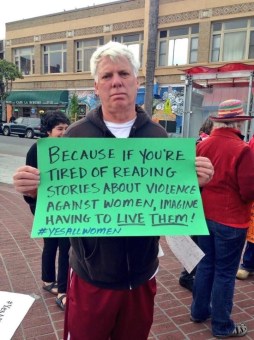
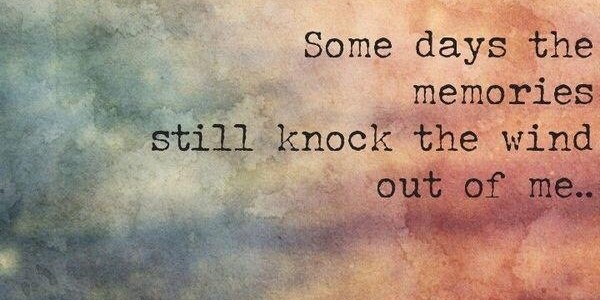
I’m going to leave you with two pictures that sum up my current mood. The first is an unknown man I found on the internet. I know this might be tiring to some of you who aren’t survivors, but this is my every day…

IMG_3559

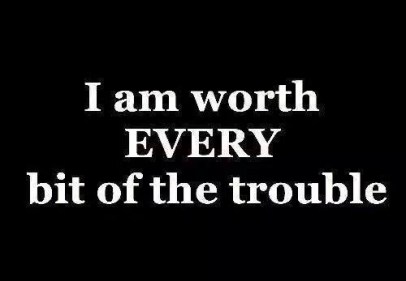
And this is a reminder to myself, and to every other survivor out there…we matter, our stories, our lives, our fears, our hopes all matter, and we are worth the “trouble” we cause the world by speaking up.

IMG_1728

SAAM Days 7 to 9 – Math

Apologies for the lack of posts the last couple of days. I needed a bit of a break for my own heart, and soul, and then I managed to get the cold that’s going around and needed a break so I could stop coughing and snuffling.

Today I’d like us to think about numbers, and do some math. I know, it’s not the most exciting bit, and indeed some dread the math, but it’s important that we get a picture of the scope of the problem of rape & sexual violence. So take a breath…

In the U.S. there are an average of 296,066 victims (age 12 and older) of rape and sexual assault each year.

There are 31,536,000 seconds per year in a non leap year. Dividing that by the number of victims (296,066) we reach an average of one assault every 107 seconds.

Think about that … someone is assaulted every 107 seconds.
Set your timer for 107 seconds (1 minute 47 seconds) and think about it.

17.7 million women (1 out of every 6) in the U.S. have been victims of attempted or completed rapes in their lifetimes.

2.78 million men (1 out of every 33) in the U.S. have been victims of attempted or completed rapes in their lifetimes.

93% of juvenile sexual assault victims know their attacker.
Approximately 80% of adult victims know their attacker.

For every 100 rapes in the U.S.

  • 46 will be reported
  • 12 will result in an arrest
  • 9 will be prosecuted
  • 5 will result in conviction
  • 3 will serve more than one day in jail

Less than 2% of reported rapes are found to be false allegations.

I give you these statistics to help us understand that the problem is huge. It affects people we know, we work with, we go to school with, we sit in church with. And these are conservative statistics from the U.S. Bureau of Justice. More realistically, because rape is the most underreported crime, it’s probably 1 in 3 women in the U.S. and 1 in 2 women worldwide who have been raped or sexually assaulted.

So my friends, I beg you to do something about it. Stand up for survivors. Support them. Listen to them. Make them a cup of tea and speak those most important words, “I believe you”.

And then work to change the culture we live in – don’t let rape and sexualized jokes go unchallenged; don’t allow power, prestige, sports status, or other things absolve people from responsibility for their actions; work to lobby for better support of those who do report, and for education for police officers, and attorneys who work with survivors; teach everyone about affirmative consent (about actually saying yes, and that no never, ever means yes).

(Statistics compiled from U.S. Department of Justice National Crime Victimization Survey 2000-2013; National Institute of Justice & Centers for Disease Control Prevalence Incidence, and Consequences of Violence Against Women Survey (1989); U.S. Bureau of Justice Statistics 2000 Sexual Assault of Young Children As Reported to Law Enforcement)


SAAM Day Six – why bother?

The “On This Day” feature on Facebook tells you what you were posting on a given day in previous years. Today (April 6), I was reminded that last year someone I didn’t know (met through an online conversation) took offense at my speaking out about rape & sexual assault likened me to a Nazi, and said that the men who raped me should have killed me. I wish I could say that this was the only time this kind of thing has happened, but it’s not. I get far fewer actual threats than some folks I know, but I do often come up against a question that just baffles me … why do I bother sharing my story and speaking up?

Some of the people who ask are genuinely concerned for my safety, and my mental and physical health. Most of them, however, would just like me to be quiet, to keep things to myself, to not disturb their view of the universe. They’re afraid of what survivors face each day. They’re afraid that people they know, their friends and family, have been the victims of such horrible crimes. And they particularly afraid to admit that someone they know might well have been a perpetrator. They cloak their fears in kindness, asking if it wouldn’t be better for me if I just “put it all behind you” or “move on”.

They have a point, I suppose. It is hard work, all this speaking out and advocating. As many of those closest to me will attest, it requires a lot of crying, and praying, and worrying, a fair amount of chocolate (and coffee and wine), and sometimes hiding under a blanket until I can face it all again.

But, at least for me, what is worse is the silence, bearing the story inside of me, alone. At least spoken my story can be shared, carried together with those who love and care for me. And perhaps spoken my story can change something – one person’s view of the world, one  congregation’s ability to understand and support other survivors, one community’s efforts to end rape & sexual violence.

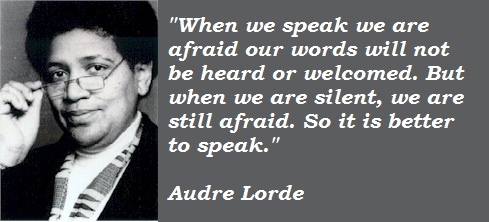
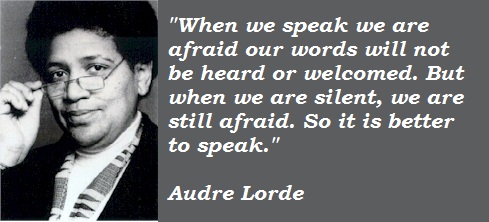
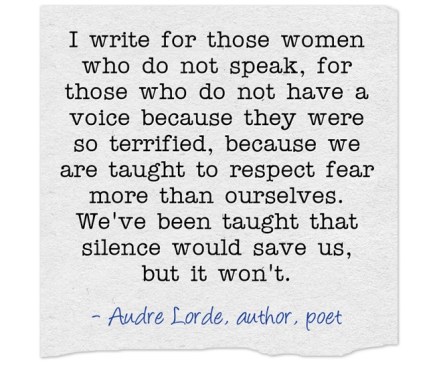
I leave you today with these words and images below from the amazing Audre Lorde (and if you don’t know who Audre is, please go forth immediately and learn about her here … Audre Lorde – Poetry Foundation … go now, seriously, she’s epic!).

audre-lordes-quotes-4

i-write-for-those-women


SAAM Day Five – Memories

When I was in high school there was an innovation in television technology called picture in picture TV. The idea was that there would be the usual picture taking up most of the screen, and then in the upper right corner you could have another smaller picture from a different channel playing. The marketing was mostly to people who wanted to be able to watch two different sporting events at the same time.

I’m not sure it ever really caught on, and then the internet came and changed how we watch TV, but the idea of picture in picture has always been a helpful way for me to describe what it’s like inside my head as a rape survivor.

Please understand that this is MY experience, and every survivor is different.

The present moment – me sitting at my computer surrounded by napping kittens, drinking coffee, thinking about worship things for Sunday, wondering if I should make oatmeal cookies, wishing I hadn’t forgotten to get tater tots at the grocery – that’s all the main picture, the big screen of the TV inside my head.

But there is always that smaller picture playing in the background. It plays on a constant loop, reliving and remembering – the events leading up to my rape, the events of the rape, and the aftermath as well.

On good days (which are most), it works with the memories quietly playing on the side while I go about my life, but there are days…

There are days, and moments, when the screens switch, when the memories are the bigger picture, and the present moment is shoved off to the side. All kinds of things can trigger the switch – stress, the weather, a particular smell or taste, having to go somewhere unfamiliar, certain days and times of the year, a song on the radio, not getting enough sleep or the right foods. And sometimes I’m not even aware of what the trigger is.

I’ve spent lots of time working with my psychiatrist at getting control of the switch, of learning how to navigate the triggers in an unpredictable world, and how to calm myself down and get my brain to bring the present back to the big picture.

IMG_0030It’s a daily practice. Some days it works, and some days it doesn’t. Some days the memories are overwhelming. Overall, I think I do it well, but I know what that kind of mental energy costs me.
Perhaps this will go a bit of the way towards helping people who aren’t survivors understand the kind of internal gymnastics that are required to go out into the world, to get the groceries, go to work, meet people, go out to eat, attend concerts and classes, and all kinds of things that a “normal” (neurotypical) brain takes for granted.

SAAM Day One ~ Everyday

April is coming to my part of Wisconsin with rain, and sleet, and probably even snow. It’s grey, and if I weren’t of Scottish descent, I would probably even find it dreary. But the weather does mean it’s a good day to make some tea, do some reading, and some plotting.

April is Sexual Assault Awareness Month (SAAM), a time when people will wear purple or teal, will post lovely things on their Facebook pages about ending sexual violence, and then in thirty days, move on to whatever the next thing is that we’re supposed to be caring about.

That sounds more bitter than I intended it to, but the reality is for survivors of sexual violence, our lives are an endless time of awareness about the realities of rape and sexual assault.

We don’t get to lay it down for the other eleven months of the year. We think about it day in and day out, some days more than others, but the reality never leaves us. It’s our waking, and most definitely our sleeping. It’s in the choices we make about where we will go, who we will go with, how late we will stay out, how we can get home, how many times we check the locks on the door after we are home, and so much more.

As we work our way through these days of April, please find ways to support the survivors you know, to listen to them, to speak the most important words you might ever say … I believe you.

And find ways to make change happen. A world without rape is a very real possibility, but it will take all of us working together to make that change happen, it will take time, and grace, and hope, and prayer, and a lot of tears. More than anything it will take the courage to speak up, and speak out.

IMG_0026

A strange (good?) thing is happening

The materials for Break The Silence Sunday (BTSS) have been out in the world for a little more than two months. They’ve been emailed to all the U.C.C. churches in Wisconsin, and have found some listening hearts in other communities from St. Louis to Phoenix, among the U.C.C., but also among Baptist, and Methodist, and ELCA Lutheran congregations. I have had some wonderful feedback, and appreciation for the idea, the materials, and the courage to open up space for this conversation.

There has also been, not entirely surprisingly, some negative feedback – people who say we don’t need yet another designated day for yet another designated topic for the church to address; people who think that this shouldn’t be discussed in church at all because it’s too personal, and too sensitive; and the folks who have said that we are, collectively, already overwhelmed with issues that matter and don’t have time for one more. I’ve handled most of that quite well, with only one major rant to my nearest and dearest friends, and only a handful of excess cookies.

But the strange, and perhaps good, thing that’s been happening is that since the materials were released an increasing number of people (clergy) have reached out to me because they need to help someone in particular in their parish with the aftermath of rape or sexual violence. These clergy come to me and tell me that they are completely unprepared, uneducated, unaware of how to help, what might be unhelpful, and they don’t know anywhere to look for resources. So they turn to me, and for that I am truly grateful, but it got me to thinking that something is lacking in how we are educating our clergy (well probably more than one thing, but I digress).

When I was in seminary we were taught to refer, refer, refer, to be careful about how much pastoral care we offered because we aren’t trained as psychiatrists, psychologists, therapists, counselors, social workers, or the like. And I understand that, BUT much of what my colleagues have been calling me to talk about isn’t the stuff of that kind of care.

In every instance the person they’re working with also has a counselor of some sort. What they need is their pastor to be present with them, to wrestle with the G-d questions, the tough stuff of faith about where is G-d when these awful things happen, and why does a G-d of love allow such stuff. They need their pastor to be part of their team, to maybe drive them to an appointment, to help them figure out how to be as safe and comfortable in worship as possible, to know that they have panic attacks at times, and be sensitive to their concerns about how we do this thing called church.

I am grateful to the colleagues who have reached out for help, who have admitted their ignorance about how rape and sexual assault affect people, and who have looked for ways to educate themselves. It has reminded me just how important the work of BTSS is, and will continue to be.

On Friday, Sexual Assault Awareness Month will begin, and we will be just 24 short days from the suggested date for the first observation of Break The Silence Sunday. I’m hoping to write often during the month (daily would be a dream, but let’s be a bit realistic here) with information, statistics, stories, quotes, and other things that might be helpful to those preparing to lead worship, attend worship, and those who aren’t ready just yet to do either.

Patience, Next Steps & Quotes

Patience
When I was young, my mother tried very hard to instill in me a good Quaker principle that she called “the right knowledge at the right time”. She was trying to teach me patience, how to wait with grace and faith, and how to trust that eventually, when the time was right and my heart and brain were ready, things would come together. Her teaching didn’t work too well since I was an incredibly impatient child (and am, perhaps, only a slightly less impatient adult).

My family comes from Clan Farquharson and our clan motto is Fide et Fortitude or, in English, By Faith and Fortitude. Fortitude is one of those lovely words we don’t use nearly enough anymore. It’s the emotional strength we have in the face of adversity, and difficulty.

Perhaps now, in my 40s, I’m finally beginning to understand what my momma, and my family motto, have been trying to teach me all these years – that sometimes we move in little steps towards a goal that no one else can see and then, eventually, at the right time everything opens up, and the miracles come.

The Revolution has been like that. I’ve been trying to get a toe in the door, even someone to listen to the voice of survivors in the church, for what seems like forever. With lots of fits and starts, a great many setbacks, a lot of nights spent crying and screaming at the silence of good people, and an enormous quantity of coffee and tea we have finally arrived at this place, a place where The Revolution is gaining traction, finding its way into people’s hearts and minds.

Next Steps (And A Bit Of A Deadline)
I am delightfully overwhelmed.

Richard Bruxvoort Colligan has written a beautiful healing service for survivors, their families, and friends, that helps remind us of the great and healing love of G-d. And today, it’s Friday I believe, I received an email from Maren Tirabassi with some incredible pieces of liturgy for Break The Silence Sunday, a prayer of confession and new words to “I Love To Tell The Story”. And friend of The Revolution Jill Hileman has gathered together an amazing collection of resources to help people throughout Wisconsin find support on their journey of healing.

As pieces of liturgy and other resources come in I try to remember that all those little steps have led to this moment, to people joining their hearts, and minds, and creativity, and voices with mine to speak up and support survivors. And for this I give great thanks.

The next couple of weeks will be a flurry of Revolution activities.

A press release type e-mail will go out in the next week or so, inviting U.C.C. congregations in Wisconsin to mark their calendars for April 24, 2016 and begin their preparations to participate in Break The Silence Sunday. If you’re not in Wisconsin, or not U.C.C., but you’d like to participate PLEASE let me know. Comment on this post, or send an email to breakthsilencesunday@gmail.com so that you can be included.

I’m also hoping to hear from more of you out there who are busy writing liturgy for us, or thinking up songs and hymns that we might suggest to congregations, or writing a sermon, or thinking up a liturgical dance, or designing a banner, or whatever creative, delightful things you’re doing. If you can get those things to me by December 20th, that would be most amazing. Yes, that’s very soon, and I understand if you can’t make that deadline. Don’t worry. Break The Silence Sunday will be an annual event, and we shall have continuing need for liturgical resources, so plan now to get things ready for the 2017 observance.

Quotes
Finally, I’m hoping some of my survivor sisters and brothers might lend me a few words about why The Revolution is important to them. I can use your name, your initials, or make them anonymous as best suits your comfort level. I’m just hoping to have some voices other than my own about why churches need to participate, to speak up, to support survivors. Drop me a note at breakthesilencesunday@gmail.com if you have a few words to share.

Thanks to all of you for reading, for your thoughts and encouragement, and for all the ways you’re supporting The Revolution.

~ MoMo

The Logo & More

We have a logo. It’s surely not as nice as it could be if someone gifted
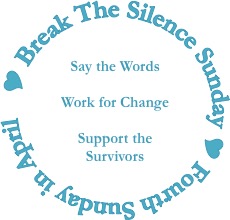
in the ways of graphic design would lend their talents, but I’m happy with it. It’s a circle which is important to me, and says the things I need it to say:

Say the words – don’t shy away from difficult words, recognizing that they’re important to some survivors, and triggering to others

BTSS Logo 2Work for change – commit yourself, and your faith community, to the work of creating a world where rape, sexual violence, and abuse are things of the past

Support the survivors – this is what it’s really all about, making a place for survivors to share their stories without guilt, shame, or bad theology

In addition, I received in my email this morning our first piece of liturgy (thanks Don N.), a prayer for hesitant clergy.

I would love to open my email every morning to your contributions to the work of Break The Silence Sunday.

The plan

Several people have asked how The Revolution is going to work. Here’s some information about how you and your congregation/community of faith can participate.


How can my congregation/faith community participate?
United Church of Christ congregations in the Wisconsin Conference will receive information about, and be invited to participate in Break The Silence Sunday automatically. Congregations outside either of that group are asked to email us at breakthesilencesunday@gmail.com with the following information:

Name & location of faith community (include denomination please)
Name & email/phone of pastoral leader
Name & email/phone of contact person (if different than pastoral leader)
How you heard about us
Anything else you think we need to know


What will we get to help us plan this event?
Preparation is key to making Break The Silence Sunday a success – people need to know what they can expect so they can prepare their hearts to be receptive, so survivors can decide if they are ready to open themselves up to this, and so parents can decide if it is age-appropriate for their children and youth to attend. You will receive advance preparation materials including bulletin inserts, and sample newsletter/website articles.

Then you will receive complete liturgies that congregations can adapt for their particular settings and context. That means you’ll receive prayers, hymn and song suggestions (for different kinds of musical needs), sermon suggestions, at least one complete sermon, ideas for communion, and more. There will be a ready to use bulletin, or you can copy and paste information into your own format.

There will also be suggestions for alternative or additional worship opportunities including a healing service.

Finally, there will be a place (on the web, perhaps hosted through the WI Conference UCC, perhaps on this blog) where congregations can find contact information for resources and support agencies in their communities.


How can I help? What else can I do?
We need all the help we can get. We need creativity, imagination, suggestions, ideas, comments, and whatever else (constructive) that you’ve got.

  • Do you like to write liturgy? We need all kinds of prayers – call to worship, gathering prayers and invocations, confessions, litanies of healing and hope, communion liturgies, offering prayers, collects, prayers of the people, petitions, pastoral prayers. You get the idea.
  • What about hymns? Think you could write a new hymn to a familiar tune?
  • Want to take a try at writing a brand new song – for the congregation to sing, for a choir or a soloist?
  • Have a passion for the scriptures – give us your best suggestions about healing (the communal/spiritual as opposed to the physical), wholeness, community, listening, honouring stories, and the like.
  • Dance? Draw? Paint? We’d love to have your ideas for gentle movements everyone could be invited to do, or dances trained groups could perform. We need art works to convey the importance of telling our stories, and the need for a community to hear us. (We’ll have a logo very soon.)

Keep in mind this will be a yearly event so we’re going to need lots, and lots of resources to keep things fresh and interesting. So start working now, and if you can’t make the deadlines (see the timeline below) that’s OK. We’re happy to collect resources and use them on an ongoing basis. E-mail us at breakthesilencesunday@gmail.com to let us know you’re interested in helping out, and to share your resources and please know that full credit, and deep gratitude, will be given to you for whatever you help create.


Timeline for Break The Silence Sunday

October 2015
Initial publicity starts to appear in places like the Wisconsin Conference UCC newsletter, Facebook, additional blog posts, and so forth.

November 2015
Additional publicity including an all church e-mail to save the date (4th Sunday in April ~ April 24, 2016).

December 2015
Liturgical resources due to us by December 20th

January 2016
Liturgy and other materials are distributed to congregations (our goal is January 10th, but it might well be the 17th).

There will also be a Steps On The Journey retreat in Phoenix, AZ held January 22-24, 2016. Registration is now open. Please visit our website for more information: http://www.azstepsonthejourney.org

February 2016
Breathing & processing – seriously, Lent starts before Valentine’s Day this year.

March 2016
Reminder time ~ emails and other communication with congregations to get them ready for the event next month.

April 2016
The event ~ April 24th

May 2016
Follow-up with communities that participated asking what they used, what helped, what they found they needed, etc. Gathering this information together so we know how to proceed for 2017, and how we might widen our audience.

June 2016
Begin planning 2017 event (this may start to take place during the WI Conference UCC annual meeting.

October 2016
Clergy retreat at Moon Beach for all UCC clergy in Wisconsin. We will be talking about shining light into the shadows, and how to address difficult subjects in the church. Our particular focus will be on suicide and sexual assault. More information after the beginning of the year.