A strange (good?) thing is happening

The materials for Break The Silence Sunday (BTSS) have been out in the world for a little more than two months. They’ve been emailed to all the U.C.C. churches in Wisconsin, and have found some listening hearts in other communities from St. Louis to Phoenix, among the U.C.C., but also among Baptist, and Methodist, and ELCA Lutheran congregations. I have had some wonderful feedback, and appreciation for the idea, the materials, and the courage to open up space for this conversation.

There has also been, not entirely surprisingly, some negative feedback – people who say we don’t need yet another designated day for yet another designated topic for the church to address; people who think that this shouldn’t be discussed in church at all because it’s too personal, and too sensitive; and the folks who have said that we are, collectively, already overwhelmed with issues that matter and don’t have time for one more. I’ve handled most of that quite well, with only one major rant to my nearest and dearest friends, and only a handful of excess cookies.

But the strange, and perhaps good, thing that’s been happening is that since the materials were released an increasing number of people (clergy) have reached out to me because they need to help someone in particular in their parish with the aftermath of rape or sexual violence. These clergy come to me and tell me that they are completely unprepared, uneducated, unaware of how to help, what might be unhelpful, and they don’t know anywhere to look for resources. So they turn to me, and for that I am truly grateful, but it got me to thinking that something is lacking in how we are educating our clergy (well probably more than one thing, but I digress).

When I was in seminary we were taught to refer, refer, refer, to be careful about how much pastoral care we offered because we aren’t trained as psychiatrists, psychologists, therapists, counselors, social workers, or the like. And I understand that, BUT much of what my colleagues have been calling me to talk about isn’t the stuff of that kind of care.

In every instance the person they’re working with also has a counselor of some sort. What they need is their pastor to be present with them, to wrestle with the G-d questions, the tough stuff of faith about where is G-d when these awful things happen, and why does a G-d of love allow such stuff. They need their pastor to be part of their team, to maybe drive them to an appointment, to help them figure out how to be as safe and comfortable in worship as possible, to know that they have panic attacks at times, and be sensitive to their concerns about how we do this thing called church.

I am grateful to the colleagues who have reached out for help, who have admitted their ignorance about how rape and sexual assault affect people, and who have looked for ways to educate themselves. It has reminded me just how important the work of BTSS is, and will continue to be.

On Friday, Sexual Assault Awareness Month will begin, and we will be just 24 short days from the suggested date for the first observation of Break The Silence Sunday. I’m hoping to write often during the month (daily would be a dream, but let’s be a bit realistic here) with information, statistics, stories, quotes, and other things that might be helpful to those preparing to lead worship, attend worship, and those who aren’t ready just yet to do either.
Patience, Next Steps & Quotes

Patience
When I was young, my mother tried very hard to instill in me a good Quaker principle that she called “the right knowledge at the right time”. She was trying to teach me patience, how to wait with grace and faith, and how to trust that eventually, when the time was right and my heart and brain were ready, things would come together. Her teaching didn’t work too well since I was an incredibly impatient child (and am, perhaps, only a slightly less impatient adult).

My family comes from Clan Farquharson and our clan motto is Fide et Fortitude or, in English, By Faith and Fortitude. Fortitude is one of those lovely words we don’t use nearly enough anymore. It’s the emotional strength we have in the face of adversity, and difficulty.

Perhaps now, in my 40s, I’m finally beginning to understand what my momma, and my family motto, have been trying to teach me all these years – that sometimes we move in little steps towards a goal that no one else can see and then, eventually, at the right time everything opens up, and the miracles come.

The Revolution has been like that. I’ve been trying to get a toe in the door, even someone to listen to the voice of survivors in the church, for what seems like forever. With lots of fits and starts, a great many setbacks, a lot of nights spent crying and screaming at the silence of good people, and an enormous quantity of coffee and tea we have finally arrived at this place, a place where The Revolution is gaining traction, finding its way into people’s hearts and minds.

Next Steps (And A Bit Of A Deadline)
I am delightfully overwhelmed.

Richard Bruxvoort Colligan has written a beautiful healing service for survivors, their families, and friends, that helps remind us of the great and healing love of G-d. And today, it’s Friday I believe, I received an email from Maren Tirabassi with some incredible pieces of liturgy for Break The Silence Sunday, a prayer of confession and new words to “I Love To Tell The Story”. And friend of The Revolution Jill Hileman has gathered together an amazing collection of resources to help people throughout Wisconsin find support on their journey of healing.

As pieces of liturgy and other resources come in I try to remember that all those little steps have led to this moment, to people joining their hearts, and minds, and creativity, and voices with mine to speak up and support survivors. And for this I give great thanks.

The next couple of weeks will be a flurry of Revolution activities.

A press release type e-mail will go out in the next week or so, inviting U.C.C. congregations in Wisconsin to mark their calendars for April 24, 2016 and begin their preparations to participate in Break The Silence Sunday. If you’re not in Wisconsin, or not U.C.C., but you’d like to participate PLEASE let me know. Comment on this post, or send an email to breakthsilencesunday@gmail.com so that you can be included.

I’m also hoping to hear from more of you out there who are busy writing liturgy for us, or thinking up songs and hymns that we might suggest to congregations, or writing a sermon, or thinking up a liturgical dance, or designing a banner, or whatever creative, delightful things you’re doing. If you can get those things to me by December 20th, that would be most amazing. Yes, that’s very soon, and I understand if you can’t make that deadline. Don’t worry. Break The Silence Sunday will be an annual event, and we shall have continuing need for liturgical resources, so plan now to get things ready for the 2017 observance.

Quotes
Finally, I’m hoping some of my survivor sisters and brothers might lend me a few words about why The Revolution is important to them. I can use your name, your initials, or make them anonymous as best suits your comfort level. I’m just hoping to have some voices other than my own about why churches need to participate, to speak up, to support survivors. Drop me a note at breakthesilencesunday@gmail.com if you have a few words to share.

Thanks to all of you for reading, for your thoughts and encouragement, and for all the ways you’re supporting The Revolution.

~ MoMo

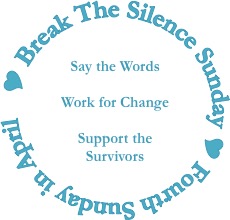
The Logo & More

We have a logo. It’s surely not as nice as it could be if someone gifted
in the ways of graphic design would lend their talents, but I’m happy with it. It’s a circle which is important to me, and says the things I need it to say:

Say the words – don’t shy away from difficult words, recognizing that they’re important to some survivors, and triggering to others

BTSS Logo 2Work for change – commit yourself, and your faith community, to the work of creating a world where rape, sexual violence, and abuse are things of the past

Support the survivors – this is what it’s really all about, making a place for survivors to share their stories without guilt, shame, or bad theology

In addition, I received in my email this morning our first piece of liturgy (thanks Don N.), a prayer for hesitant clergy.

I would love to open my email every morning to your contributions to the work of Break The Silence Sunday.

The plan

Several people have asked how The Revolution is going to work. Here’s some information about how you and your congregation/community of faith can participate.


How can my congregation/faith community participate?
United Church of Christ congregations in the Wisconsin Conference will receive information about, and be invited to participate in Break The Silence Sunday automatically. Congregations outside either of that group are asked to email us at breakthesilencesunday@gmail.com with the following information:

Name & location of faith community (include denomination please)
Name & email/phone of pastoral leader
Name & email/phone of contact person (if different than pastoral leader)
How you heard about us
Anything else you think we need to know


What will we get to help us plan this event?
Preparation is key to making Break The Silence Sunday a success – people need to know what they can expect so they can prepare their hearts to be receptive, so survivors can decide if they are ready to open themselves up to this, and so parents can decide if it is age-appropriate for their children and youth to attend. You will receive advance preparation materials including bulletin inserts, and sample newsletter/website articles.

Then you will receive complete liturgies that congregations can adapt for their particular settings and context. That means you’ll receive prayers, hymn and song suggestions (for different kinds of musical needs), sermon suggestions, at least one complete sermon, ideas for communion, and more. There will be a ready to use bulletin, or you can copy and paste information into your own format.

There will also be suggestions for alternative or additional worship opportunities including a healing service.

Finally, there will be a place (on the web, perhaps hosted through the WI Conference UCC, perhaps on this blog) where congregations can find contact information for resources and support agencies in their communities.


How can I help? What else can I do?
We need all the help we can get. We need creativity, imagination, suggestions, ideas, comments, and whatever else (constructive) that you’ve got.

  • Do you like to write liturgy? We need all kinds of prayers – call to worship, gathering prayers and invocations, confessions, litanies of healing and hope, communion liturgies, offering prayers, collects, prayers of the people, petitions, pastoral prayers. You get the idea.
  • What about hymns? Think you could write a new hymn to a familiar tune?
  • Want to take a try at writing a brand new song – for the congregation to sing, for a choir or a soloist?
  • Have a passion for the scriptures – give us your best suggestions about healing (the communal/spiritual as opposed to the physical), wholeness, community, listening, honouring stories, and the like.
  • Dance? Draw? Paint? We’d love to have your ideas for gentle movements everyone could be invited to do, or dances trained groups could perform. We need art works to convey the importance of telling our stories, and the need for a community to hear us. (We’ll have a logo very soon.)

Keep in mind this will be a yearly event so we’re going to need lots, and lots of resources to keep things fresh and interesting. So start working now, and if you can’t make the deadlines (see the timeline below) that’s OK. We’re happy to collect resources and use them on an ongoing basis. E-mail us at breakthesilencesunday@gmail.com to let us know you’re interested in helping out, and to share your resources and please know that full credit, and deep gratitude, will be given to you for whatever you help create.


Timeline for Break The Silence Sunday

October 2015
Initial publicity starts to appear in places like the Wisconsin Conference UCC newsletter, Facebook, additional blog posts, and so forth.

November 2015
Additional publicity including an all church e-mail to save the date (4th Sunday in April ~ April 24, 2016).

December 2015
Liturgical resources due to us by December 20th

January 2016
Liturgy and other materials are distributed to congregations (our goal is January 10th, but it might well be the 17th).

There will also be a Steps On The Journey retreat in Phoenix, AZ held January 22-24, 2016. Registration is now open. Please visit our website for more information: http://www.azstepsonthejourney.org

February 2016
Breathing & processing – seriously, Lent starts before Valentine’s Day this year.

March 2016
Reminder time ~ emails and other communication with congregations to get them ready for the event next month.

April 2016
The event ~ April 24th

May 2016
Follow-up with communities that participated asking what they used, what helped, what they found they needed, etc. Gathering this information together so we know how to proceed for 2017, and how we might widen our audience.

June 2016
Begin planning 2017 event (this may start to take place during the WI Conference UCC annual meeting.

October 2016
Clergy retreat at Moon Beach for all UCC clergy in Wisconsin. We will be talking about shining light into the shadows, and how to address difficult subjects in the church. Our particular focus will be on suicide and sexual assault. More information after the beginning of the year.

Integrity, Shame & Hymns

It’s been an interesting few days here in the land of The Revolution. Maybe I’ve been stirred up by the full moon, and the eclipse, or maybe it’s just that vulnerability is a risky enterprise which oftentimes threatens those who cling to structures of oppression.

First, over the weekend I was told that I am, through this work, destroying the integrity and honour of my family. It’s not a new rant, that somehow I’m a disgrace because I speak out about being a survivor, but it still makes me sad, and angry. Thankfully I have an amazing group of chosen family who are willing to listen to me rant, and cry, and process my thoughts and feelings, but I wonder about the survivors who don’t have that kind of support system. What happens when a survivor is rejected by their family AND doesn’t have any other community to stand with them? Shouldn’t this be precisely the place the church steps in to be that community, to be a place where survivors can tell their stories, to be heard without judgement, to find the courage to move forward in healing, hope, and faith?

Second, I was at the market this morning. I am in the habit of wearing a button that says “This is what a rape survivor looks like”. Usually the button invites good conversation, compassion, and sometimes I am honoured to hear other people’s stories of survival. Today, however, the woman in front of me at the registers had a different approach. She looked at me, read the button, looked at me again and then said, “you should be ashamed of yourself”. This woman, totally unknown to me, decided to pass judgement, to decide that I should bear the responsibility, shame, and guilt for what happened to me. I get it. I, and most survivors I know, struggle with it already. It’s called survivor guilt, and it needs to stop, today. The woman at the store, the culture around us, all just need to stop. All the responsibility for what happened to me, and to all survivors, belongs to the people who hurt us.

My third rambling will seem unrelated, but hear me out. We need some new hymns that dare to use the word RAPE. I’ve talked with lots of survivors and one of the things we struggle with the stigma around that word, the fact that people don’t want to say it, that it makes them uncomfortable. Guess what – it’s even harder for survivors, but we need you to be brave, to face that which makes you uncomfortable, to deal with your own stuff and support us. I’ll probably write loads more on that soon, but for right now I’m thinking about needing some new hymns, probably to tunes we already know, that use the word rape. No, it won’t be easy to do, to find a way to faithfully, and honestly use that word in song, but I have no doubt the grace of G-d can get us there. Anybody want to try?

A song for The Revolution…

Music is an incredibly important part of my healing, as it is for many of my brother and sister survivors.

In the summer of 2014 my dear friend Bryan Sirchio, a gifted musician working to make the world a better place, and I wrote a song to tell parts of my story. He persists in telling me that it’s “my” song, but I will forever think of it as “our” song.

The whole process surrounding the song – from dreaming of it, to writing it together in the heat at Pilgrim Center, to recording it, to performing it, and sharing it – has been part of the tipping point, moving The Revolution forward.

I struggle with embracing my singing voice, having been told that I don’t sing well. But perhaps that’s the point of the song. It’s title is “I Need You To Hear”. I don’t like to admit that, but it’s true. I need to be heard, to tell my story in my own voice, with my own words, no matter how clumsy they might be at times, no matter how far out of tune I am.

I think that’s true for many (I might even dare to say most) survivors – we need you to listen, to hear, to speak, to know that you aren’t going to run away when it gets tough, when the words make you uncomfortable, when you would rather look the other way and pretend that rape simply doesn’t exist.

The video here is of Bryan and I singing together after I gave the keynote speech at Ten Points of Light to Take Back The Night at Moraine Park Technical College in Fond du Lac, WI in April of this year.

Please also check out Bryan’s work at http://sirchio.com/and his incredible work with the people of Haiti at http://www.haitiallies.org/

A poem while I work on some others

I’m working on some new poems for The Revolution today, and letting a couple of ideas for hymns/congregational songs simmer in the back of my brain (and heart), but in the meantime I wanted to share this poem I wrote several years ago as a manifesto (which word I have just looked up … a public declaration of intention, objective, or motive … and seems most appropriate).

“Sometimes I Wonder”
Moira Finley, August 2012 & revised August 2013

Sometimes,
in the small hours of the night
when the voices
of a million screaming women
keep me from sleep,
I wonder what it would be like
if we all just sat down
and stopped
because we’d finally had enough.

If we gathered up
our saris and burkhas,
nursing bras and corsets,
cotillion dresses and uniforms,
our suits and G-strings,
running clothes and pyjamas,
jeans and habits,
and settled ourselves in
for a nice long wait
until the world finally admitted
that enough was enough,
that rape must come to an end.

I dream of that day,
when over a cup of tea,
or coffee or simply cool clear water,
we calmly state our demands.

We require a world where we teach
that you should not rape
instead of how to avoid being raped;
that every person is sacred
and deserves to be respected,
to have their own voice,
a right to the sanctity and dignity
of their own bodies,
to an education and
the encouragement to use
their minds, their hearts, and their souls,
to follow their dreams.

We require a world where
girls and women can safely
walk down the street
wearing a bikini or a hijab,
and sit in their own homes,
without fear that their
bodies and hearts and souls
would be torn apart
by the violation of someone else’s anger,
by the hatred of someone’s violence,
by the searing pain of rape
which will follow them,
endlessly replaying
in their hearts and minds,
for the rest of their lives;
and where this is equally true
for boys and men.

We require a world where
our daughters and sons
never feel compelled to cooperate
with things that make them
hate their bodies,
at the hands of those
they should be able to trust;
where power over others
is a memory best to be forgotten.

I wonder what would happen
if the labourers in the fields,
office workers and nurses,
teachers and store clerks,
business owners and farmers,
mothers and grandmothers,
athletes and firefighters,
all of them women,
simply stopped and sat down
and demanded a world of peace,
a world free from rape and violence,
from shame and degradation,
from buying and selling human flesh,
from oppression and tyranny.

Would it matter?
Would the world notice?
Would it change anything
if more than half the world
failed to show up for work one day?
Would our strength be praised,
or our bravery condemned?

Would the men we love,
who say they love us,
take a stand with us,
use their voices and their power
on our behalf,
to advocate for us,
to share our dream,
to help create it?

Sometimes,
as the first rays of dawn
creep through my bedroom window,
I wonder what it would be like
if there were no more voices
crying in the night,
no more lives torn apart by rape,
and what it would be like
if the dream came true.

Welcome to The Revolution

My name is Moira Finley. I am many things – a poet, a painter, someone who loves a good meal, a potentially crazy cat lady, a fan of all things Sherlock Holmes, someone who is mildly (ok, intensely) obsessed with Harry Potter, the pastor of two wonderful United Church of Christ (UCC) congregations, and a rape survivor.

I was raped when I was thirteen.

It has been twenty-eight years since the night that changed everything. Along the way I have been blessed to be surrounded by a great many people who have loved me when I didn’t feel loveable; who have held me together when I was falling apart; who have cried with me, laughed with me, tried to understand my anger, listened to my questions, and struggled with me to make sense of all that happened to me.

One of the most important, and most difficult, parts of my journey (and the journey of many survivors) has been wrestling with questions of faith. Where was G-d when I was raped? If G-d loves me, why didn’t G-d prevent it from happening? Can G-d still love me even though I’m tainted, broken, dirty? There are questions about suffering, grace, mercy, hope, forgiveness, and so much more.

My mother, and the church I grew up in, were wonderful about helping me wrestle with those questions, but I know many survivors are not so lucky. Their congregations, their pastors, their communities meet them with outdated and hurtful theologies, dangerous ideas about what is required to be a Christian, and have laid blame, and shame at the feet of survivors.

When I was ordained in the UCC I had high hopes that my own denomination might be a place where survivors could find space to share their stories, to be heard, honoured, and respected. After all, ours is a tradition of justice seeking, and peace making, advocating for those who have been marginalised, and lifting up the voices of those who have been silenced and oppressed.

Sadly, this has not been my experience. For the fourteen years since my ordination I have been trying to get the UCC, and the church in general, to open up a space for this conversation – to support survivors and advocate for change. I have been met with what feels like a firmly closed, and locked door.

Responses have ranged from the fairly mundane of “it’s private and personal” and “it will make people uncomfortable” to the genuinely hurtful “it’s not an important issue for the church”. I have received theological advice that was well intentioned, but seriously misguided including the platitudes about Jesus suffering, and that nonsense about G-d not giving us more than we can handle. I have been instructed that forgiveness, immediate and unconditional, is a requirement of the Christian faith, and that I shouldn’t be angry about what happened to me because it might upset others. I have been told that PTSD (Post Traumatic Stress Disorder) is stupid, that I should just get over it since it all happened a long time ago, that stuff like this happens to everyone and I should just accept it, and so much more.

But I am stubborn, or brave, or foolish, or more probably a combination of all three. I have refused to give up, to back down from my belief that the church is, and can be, a place where survivors can tell their stories; can receive love, encouragement, and support in their healing; and can find a way through their pain with faith.

It has been a trying, difficult time. There has been a lot of crying, some screaming, and a lot of wondering if I was on the right track, if this really mattered, if the work was worth it.

Then something started to happen. In the summer of 2014 my dear friend Bryan Sirchio and I wrote a song about my story. The song started to get shared. I got invited to be the speaker at a Take Back The Night event in Fond du Lac in April 2015 where, after my speech, Bryan and I performed the song. That video got shared some more. And then we reached the tipping point.

Our new Wisconsin Conference UCC minister has agreed to help me push open the door and Break The Silence Sunday was born.

We are working, first within the UCC in Wisconsin and eventually much broader, to create a Sunday when the church will, in worship
say the word rape, acknowledging the reality of rape in our world;
support and encourage survivors in their journey of healing;
and commit themselves to working for change.

It won’t be easy, or quick, but I believe it will be worth it because together we can help survivors know that, despite what happened to them, they are beloved children of G-d, and that the church stands with them, outraged at their experience, and working together towards a world where no one else ever has to live through such things.

This blog will be reflections from those helping to create this Sunday: crafting liturgy, writing sermons, sharing songs and hymns, offering prayers. There will also be writings (ramblings), poems, visual arts, music, and other things that help move us together towards a place of healing, wholeness, and hope.

So, welcome to The Revolution. I am grateful you are here.